REVA University BBA Admissions 2026
Last Date to Apply: 17th August | QS I-Gauge Diamond Rated | NAAC A+ Accredited | 621 Recruitment Partners | INR 40 LPA Highest CTC | 4482 Job offers


Searching in Data Structure plays a pivotal role in retrieving specific information efficiently. The process of searching involves locating a particular element within a data structure, be it an array, list, tree, or any other organised collection of data. Different search methods in data structure are employed based on the nature of the data structure and the requirements of the search operation.
This Story also Contains
In this article, we will explore the concept of searching in data structure, explore various searching methods in data structure, and discuss the types of searching techniques that are commonly used. Consider learning these Computer Science Certification Courses.
Also Read:
Searching in Data Structure is a fundamental operation in computer science that involves finding a specific item or element from a collection of data. The efficiency of a search algorithm is crucial, especially when dealing with large datasets, as it directly impacts the overall performance of a system. Different data structures support various types of search operations, each with its own advantages and limitations.
Also Read:
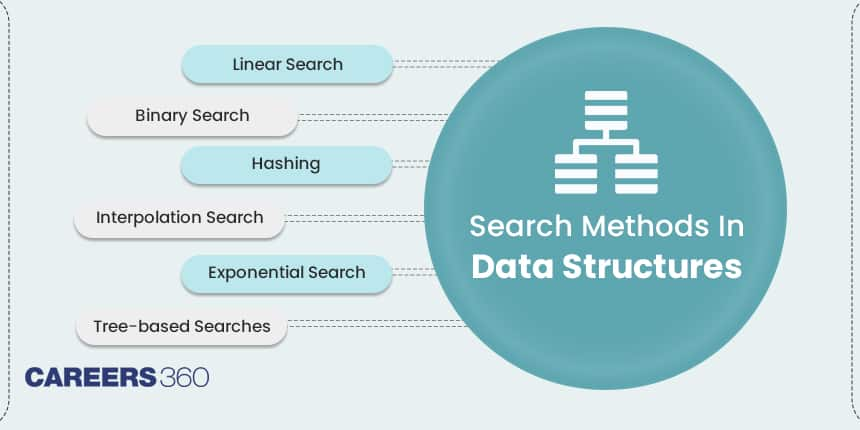
Search methods in Data Structure play a pivotal role in optimising the performance of systems dealing with diverse datasets. Ranging from basic linear searches to binary search in data structure, hashing techniques, and tree-based methods, the following points highlights the different searching techniques in data structure:
Linear searching in data structure is a straightforward method where each element in the data structure is examined one by one until the desired element is found. It is a simple approach applicable to unsorted lists or arrays. While linear search is easy to implement and understand, its time complexity is O(n), making it less efficient for large datasets.
In the worst case you might need to match every element till the very end of the list. Hence, linear search cannot be used at scale.
Binary search in data structure is a more efficient algorithm applicable to sorted arrays or lists. It operates by repeatedly dividing the search interval in half. By comparing the middle element with the target value, the algorithm can eliminate half of the remaining elements at each step.
Binary search has a time complexity of O(log n), making it significantly faster than linear search for large datasets. This is particularly helpful when the data is already sorted.
Hashing involves the use of hash functions to map keys to specific locations in a data structure, usually an array or hash table. This method enables direct access to the desired element in constant time on average. Hashing is widely used in scenarios where quick retrieval is essential, such as in hash tables.
Interpolation search is an improvement over binary search, especially when the data is uniformly distributed. It uses the value of the target element and estimates its position based on the assumption of a uniform distribution. While interpolation search can be more efficient than binary search in certain cases, it requires sorted data and may not perform well with unevenly distributed datasets.
Exponential search is a combination of binary search and linear search. It starts with a small range and doubles the size of the search interval until the target element is likely to be present. Once the interval is identified, binary search is applied within that range. Exponential search is particularly useful for unbounded arrays.
For hierarchical data structures like binary search trees (BST) or AVL trees, specific search methods are employed. In a binary search tree, elements are organised in a way that makes searching more efficient. Tree-based searches include in-order traversal, pre-order traversal, and post-order traversal, each providing a different way of accessing and retrieving elements.
Also Read: Free Data Analysis Certification Courses
Various searching methods in data structure have been developed to cater to diverse data structures and requirements, each with its unique set of advantages and limitations. From the straightforward linear search to the sophisticated binary search, and encompassing hash-based techniques and tree-based searches, understanding the types of searching methods is fundamental for computer scientists, programmers, and engineers alike. The following points highlight the different types of searching in data structure:
Sequential search methods, such as linear search, involve examining each element in a sequential manner until the target is found or the end of the data structure is reached. While simple, sequential searches may not be the most efficient for large datasets.
Interval searches, like binary search and exponential search, involve narrowing down the search space progressively. These methods are particularly effective for sorted datasets and provide faster search times compared to sequential searches.
Hash-based searching involves the use of hash functions to quickly locate elements in a data structure. This method is commonly used in hash tables and provides constant-time average-case performance for search operations.
Search methods for trees, such as binary search trees, leverage the hierarchical nature of the data structure. These methods include in-order, pre-order, and post-order traversals, each determining a different sequence for accessing elements.
Related: Popular Computer Science Certification Courses from Top Providers
Last Date to Apply: 17th August | QS I-Gauge Diamond Rated | NAAC A+ Accredited | 621 Recruitment Partners | INR 40 LPA Highest CTC | 4482 Job offers
Ranked No. 2 Business School in India and no. 26 in world by Financial Times MiM 2026 Ranking | Highest CTC: INR 75 LPA
The choice of a particular search method depends on factors such as the type of data structure, the distribution of data, and the specific requirements of the search operation. Understanding various search methods in data structure is essential for designing and implementing effective algorithms in the realm of data structures.
As technology continues to evolve, the importance of optimising search operations will remain a key consideration in the development of efficient and responsive systems.
Frequently Asked Questions (FAQs)
Searching in data structures is the process of locating a specific element within a collection of organised data. It involves systematically scanning or navigating through the data to find the desired information efficiently.
Linear search involves sequentially examining each element, making it suitable for unsorted data. In contrast, binary search is more efficient and applicable to sorted data.
It is crucial for efficiently retrieving specific information, influencing the overall performance of computer systems, particularly when dealing with large datasets.
Internal searching in data structures refers to the process of locating an element within a structure stored in the computer's primary memory, such as RAM. External searching, on the other hand, involves finding elements in structures that extend beyond the computer's primary memory such as hard drives or SSDs.
There are several types of searching methods in data structures, including linear search, binary search, hashing, interpolation search, exponential search, and tree-based searches.

On Question asked by student community
Hello Ayush,
For the WBCHSE Class 12 Semester 3 Computer Science Question Paper 2025, you can access the Careers360 resource below. The Semester 3 exams were conducted in September 2025, and the Computer Science paper is available for download.
Hello Student, Pune district mein B Sc . Computer Science ke liye aapko government, aided, autonomous aur private colleges ke options mil sakte hain. College choose karte waqt sirf naam nahi, balki fees, affiliation, accreditation, syllabus, faculty, computer labs, internship opportunities, placements aur location bhi compare karein.
Hello,
To download the 2nd PUC CS Question paper PDF, click on the link given below.
https://school.careers360.com/download/ebooks/karnataka-2nd-puc-computer-science-preparatory-exam-question-paper-2025-26
Dear Student,
Getting admission to a Diploma in Computer Science requires you to pass Class 10 with a minimum of 50% marks. The admission process for a Diploma in Computer Science follows certain steps, which are as follows:
Hello,
Yes, if you are eligible through the lateral entry/admission process and Nirma University allows branch allotment to Computer Science and Engineering, then there is generally no restriction because your diploma was in Electrical Engineering.
However, you must satisfy the university's eligibility criteria and admission rules. Since CSE is a

Globally Recognized by AACSB (US) & AMBA (UK) | 18 LPA Avg. CTC for PGPM 2026
Among top 100 Universities Globally in the Times Higher Education (THE) Interdisciplinary Science Rankings 2026
Among top 100 Universities Globally in the Times Higher Education (THE) Interdisciplinary Science Rankings 2026
Among top 100 Universities Globally in the Times Higher Education (THE) Interdisciplinary Science Rankings 2026
100% Placements with 260+ Recruiters
Test centres are available in 70+ cities across India | 75,000+ aspirants apply for the NMAT exam | Accepted by 58+ institutions like NMIMS, KJSIM, ISB, SPJIMR and Great Lakes.